
Before the Big Temple: What Was Thanjavur Like 1,000 Years Ago?
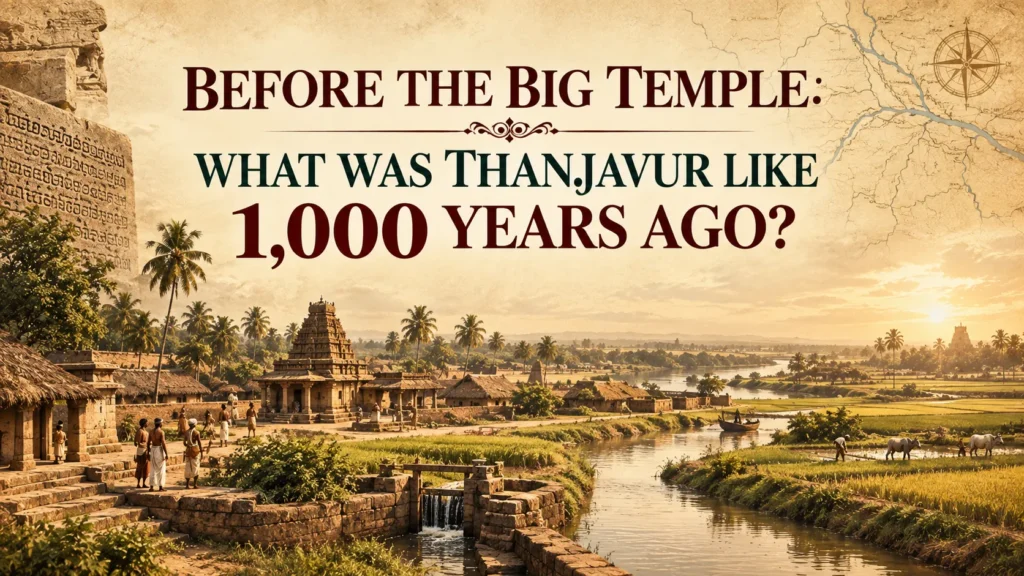
Before the Big Temple: What Was Thanjavur Like 1,000 Years Ago?
Stand in front of the Brihadisvara Temple today and it is easy to imagine that the history of Thanjavur began with this extraordinary monument.
It did not.
The temple was completed in the early 11th century during the reign of Rajaraja Chola I. UNESCO identifies the Brihadisvara Temple at Thanjavur as one of the great monuments of the Chola period and dates its construction to the reign of Rajaraja I, around 1000–1010 CE.
But the temple was built within an existing landscape.
There were already settlements.
There were agricultural fields.
There were waterways.
There were temples and religious institutions.
There were people cultivating land, trading goods and managing the resources of the region.
And, most importantly, Thanjavur had already become important enough to serve as the capital of the powerful Chola kingdom.
So what did this place look like before the enormous granite tower dominated its skyline?
The answer is more interesting than simply saying that it was an “ancient city.”
Thanjavur was already a living landscape before the Big Temple gave it its most famous landmark.
The Temple Was New. Thanjavur Was Not.
One of the easiest misconceptions about historical cities is to imagine that a famous monument suddenly created the city around it.
That is not what happened at Thanjavur.
By the time Rajaraja Chola I began building the Brihadisvara Temple, Thanjavur was already associated with the Chola state.
The Cholas had captured Thanjavur from the Muttaraiyars in the 9th century. Historical accounts generally associate Vijayalaya Chola with the capture of Thanjavur around the middle of the 9th century, after which it became an important Chola centre.
This means that by Rajaraja’s time, Thanjavur had already experienced generations of political change.
The Big Temple was therefore not the beginning of Thanjavur’s story.
It was a monumental statement made at a particular moment in an already established city.
Imagine Thanjavur Around the Year 1000
There is a problem when we try to picture a city from 1,000 years ago.
We have photographs of Thanjavur from the last few centuries.
We have surviving buildings.
We have inscriptions.
We have archaeological remains.
But we do not have a photograph showing exactly what the entire city looked like in 1000 CE.
So we have to reconstruct the landscape from evidence.
Inscriptions are particularly important.
The Brihadisvara Temple itself preserves a remarkable collection of inscriptions from Rajaraja’s reign. These records document donations, land, personnel, temple administration and other details connected with the institution. The Archaeological Survey of India and UNESCO recognise the importance of these inscriptions in understanding Chola administration and temple life.
They allow us to glimpse something much more valuable than a postcard view.
They allow us to see how the city worked.
A Landscape of Fields and Water
If you could stand outside Thanjavur 1,000 years ago, one of the first things you would probably notice would not be a giant stone tower.
You would notice the landscape.
Thanjavur lies within the fertile Cauvery delta, a region deeply shaped by the river and its branches.
The delta’s agricultural productivity depended upon the management and distribution of water.
The Grand Anicut, traditionally attributed to the Chola period, is one of the most famous examples of this long history of water management. The Central Water Commission and other institutional sources document the development of the Cauvery’s irrigation network and its branches across the delta.
This matters when imagining medieval Thanjavur.
The city did not exist separately from its countryside.
The fields were part of the city’s economy.
Rice cultivation generated agricultural wealth.
Water management supported cultivation.
Land generated revenue.
And that revenue supported political, religious and administrative institutions.
So the Thanjavur of Rajaraja’s time should be imagined as a city connected intimately to a much larger agricultural region.
Rice Was More Than Food
For a modern visitor, a paddy field may simply look like part of the scenery.
For the Chola state, cultivated land represented something much more significant.
Agriculture was closely connected to taxation, land administration and the financing of institutions.
Chola inscriptions contain extensive information about land, donations, irrigation and administrative arrangements.
The inscriptions at the Brihadisvara Temple are particularly revealing.
They record gifts of land, gold, livestock and other resources to the temple and provide details about how the institution was organised.
This gives us an important clue about the society surrounding the temple.
The enormous building was not an isolated architectural project.
It was supported by an economic system.
Behind the granite were:
fields, farmers, administrators, craftsmen, merchants, donors and institutions.
Who Lived in Thanjavur?
This is where the picture becomes especially interesting.
A thousand years ago, Thanjavur was not simply populated by kings and priests.
A functioning capital required a much wider population.
There were agricultural workers.
Artisans.
Metalworkers.
Stoneworkers.
Carpenters.
Merchants.
Administrators.
Temple personnel.
Musicians.
Dancers.
Servants.
Military personnel.
And many others whose names have disappeared from popular history.
The Brihadisvara inscriptions provide evidence of the large and complex organisation associated with the temple.
They record numerous personnel and resources connected with temple activities.
This means that the medieval city must have been a busy place.
Not necessarily busy in the modern sense of traffic and crowded streets.
But busy with human activity.
People arriving.
Goods moving.
Food being produced.
Buildings being constructed.
Rituals being performed.
Taxes being collected.
Records being written.
And water being distributed.
The People Who Built the Big Temple
His role was enormous.
But one king could not physically construct such a monument.
The temple required a huge network of specialists.
Stone had to be quarried and transported.
Blocks had to be shaped.
Architectural measurements had to be established.
Sculptures had to be designed and executed.
Metal objects had to be produced.
Timber had to be worked.
Food had to be supplied to workers.
Tools had to be manufactured.
Administrative records had to be maintained.
The temple therefore tells us something about the sophistication of the society that built it.
The Big Temple was not just the achievement of a king. It was the achievement of an entire civilisation’s workforce.
Thanjavur’s Skyline Looked Very Different
Today, the Brihadisvara Temple dominates the historical image of Thanjavur.
Its vimana rises dramatically above the surrounding complex.
But before its construction, that particular skyline did not exist.
There may have been smaller temples, religious buildings, residences, administrative structures and agricultural spaces.
The architectural landscape would have been lower and more varied.
The great granite temple changed the visual identity of the city permanently.
It became both a religious centre and a powerful expression of Chola authority.
UNESCO describes the Brihadisvara Temple as an outstanding example of Chola architecture and notes its influence on later South Indian temple architecture.
Imagine approaching Thanjavur before that happened.
There would have been no enormous Rajarajesvaram tower waiting on the horizon.
The most recognisable image of Thanjavur had not yet been created.
But There Were Already Temples
Saying “before the Big Temple” does not mean that Thanjavur was a city without temples.
The Chola period was characterised by extensive temple building and patronage.
The Brihadisvara Temple itself represents the culmination of architectural and religious developments that had already taken place.
Rajaraja did not invent the South Indian temple tradition.
He built upon an existing cultural and architectural world and took it to an extraordinary scale.
That distinction is important.
The Big Temple should therefore be understood as both:
a continuation of an existing tradition
and
a dramatic transformation of that tradition.
Thanjavur Was a Political Capital
The biggest change in Thanjavur’s history came when it became closely associated with Chola political power.
Vijayalaya Chola’s capture of Thanjavur in the 9th century established the city as an important Chola centre.
Later rulers expanded Chola territory dramatically.
By Rajaraja Chola I’s reign, the Chola state had become one of the most powerful political forces in southern India.
Thanjavur therefore occupied a very different position from an ordinary agricultural settlement.
It was connected to the administration of a large kingdom.
Orders had to be issued.
Revenue had to be managed.
Military resources had to be organised.
Religious institutions had to be supported.
Land had to be recorded.
The city needed people capable of performing all these functions.
The temple inscriptions provide a rare window into this administrative world.
A City of Records
Perhaps one of the most surprising things about medieval Thanjavur is how much information was recorded.
The Cholas were prolific inscription makers.
Stone walls became administrative records.
They could preserve information about:
* land donations
* taxes
* temple endowments
* individuals
* villages
* livestock
* gold
* lamps
* agricultural resources
* temple personnel
* administrative arrangements
The inscriptions of Brihadisvara are therefore much more than religious texts.
They are historical documents.
They allow historians to reconstruct aspects of the economic and administrative world surrounding the temple.
In a sense, the walls of the Big Temple became an archive carved in stone.
What Did Ordinary Streets Look Like?
This is one question we cannot answer with complete certainty.
We should be careful here.
There is a tendency in popular history to describe ancient streets in vivid detail even when there is no reliable evidence for every feature.
We should not pretend to know the exact appearance of every street in Thanjavur around 1000 CE.
But we can make reasonable historical deductions.
A functioning capital would have needed residential areas, workspaces, markets, religious institutions, storage areas and routes connecting the city with surrounding settlements.
The movement of agricultural produce would have been essential.
So would the movement of craftsmen, merchants and officials.
The city would have been connected to the countryside rather than separated from it.
And waterways would have been part of the larger economic landscape.
The Cauvery Was Part of the Story
The Cauvery is sometimes treated as background scenery in discussions about Chola history.
It shouldn’t be.
The river system was one of the foundations upon which the agricultural economy of the delta developed.
The Central Water Commission’s historical documentation describes the complex branching and irrigation arrangements associated with the Cauvery downstream of the major diversion structures.
For Thanjavur, water meant agriculture.
Agriculture meant food.
Food supported people.
Agricultural production generated revenue.
And revenue supported the institutions of the kingdom.
So the relationship between river → agriculture → wealth → state → temple is an important part of understanding medieval Thanjavur.
The Temple Was Also an Economic Institution
The Brihadisvara Temple was not simply a place where people came to pray.
Its inscriptions reveal an institution with substantial resources and a large organisational structure.
Land and other assets were assigned to support its activities.
People were appointed for different responsibilities.
Resources were required for lamps, rituals, maintenance and daily operations.
This makes the temple an important window into the economy of its period.
The enormous building was effectively embedded in the economic life of the surrounding region.
That is one reason the inscriptions are so valuable.
They help us move beyond the romantic image of a king building a temple and towards a more complicated picture of administration, resources and society.
A World of Artisans
Look closely at the Big Temple and another part of medieval Thanjavur becomes visible.
The sculptures.
The inscriptions.
The stonework.
The bronze tradition associated with the Chola period.
The architectural precision.
None of these appeared by accident.
They depended upon specialised knowledge passed between generations.
The Chola period is particularly famous for its bronze sculptures, and Chola artistic traditions continue to influence the cultural identity of the region.
This is another reason Thanjavur’s modern reputation for art and craftsmanship has such deep historical roots.
The city did not suddenly become a centre of artistic culture in recent centuries.
The roots go much deeper.
What Was Missing From Thanjavur 1,000 Years Ago?
The easiest answer is obvious.
There were no modern roads.
No buses.
No electricity.
No cinema theatres.
No railway station.
No concrete apartment buildings.
No automobiles.
No mobile phones.
No modern municipal infrastructure.
But there is something more interesting that would also have been missing.
There would have been no separation between “heritage Thanjavur” and “ordinary Thanjavur.”
The temple was part of everyday life.
Agriculture was part of the economy.
Religious institutions were part of administration and society.
Craft production was part of the city’s identity.
The landscape itself was part of the political and economic system.
The modern idea of heritage—where we visit an old monument as a separate attraction—did not exist in the same way.
People were simply living within that world.
And Then Rajaraja Changed the City Forever
Around the beginning of the 11th century, Rajaraja Chola I commissioned the monumental temple dedicated to Shiva, known today as the Brihadisvara Temple.
The temple was completed around 1010 CE.
Its scale was extraordinary.
Its vimana rose dramatically above the city.
Its inscriptions recorded an enormous amount of information.
Its architectural influence extended far beyond Thanjavur.
UNESCO considers the temple and the wider group of Chola monuments to be outstanding examples of Chola architecture and recognises their influence on later South Indian architecture.
The temple therefore became more than another building.
It became the symbol through which later generations would remember Thanjavur.
But the Real Story Is Bigger Than the Temple
If you visit Thanjavur today, it is natural to begin with the Big Temple.
You should.
It is extraordinary.
But after seeing it, try something different.
Look beyond the monument.
Think about the fields surrounding the city.
Think about the waterways.
Think about the people who worked the land.
Think about the craftsmen who shaped stone.
Think about the administrators who recorded land and donations.
Think about the people whose names appear in inscriptions but rarely appear in modern history books.
Think about the city before the tower existed.
Because the most fascinating question is not:
“How did Rajaraja build the Big Temple?”
It is:
“What kind of city already existed that was capable of building something like it?”
That question leads us into a much deeper history of Thanjavur.
Thanjavur Before the Big Temple: What We Can Actually Say
Based on surviving historical and archaeological evidence, we can confidently say that by Rajaraja Chola I’s period:
* Thanjavur was already an important Chola political centre.
* The surrounding region was deeply connected to Cauvery-delta agriculture.
* Irrigation and water management were essential to the agricultural economy.
* The city and its surrounding settlements supported a complex population of workers, artisans, administrators, religious personnel and others.
* Temple institutions were deeply connected to land, resources and administration.
* Chola inscriptions provide unusually detailed evidence about the society and economy of the period.
* The Brihadisvara Temple represented a monumental expansion of an existing religious and architectural tradition rather than the beginning of Thanjavur’s history.
What we cannot confidently reconstruct is every street, house, market or neighbourhood of Thanjavur around exactly 1000 CE.
That is where responsible local history needs to distinguish between evidence and imagination.
The Thanjavur We Don’t Usually See
The Thanjavur most people know is a city of monuments.
The Thanjavur that existed before the Big Temple was a city of people, fields, water, administration, craftsmanship and religious institutions.
The temple gave that city its most famous architectural symbol.
But the city existed before the symbol.
And perhaps that is the most interesting way to look at Thanjavur.
When you stand before the Big Temple, you are not standing at the beginning of the story.
You are standing at the point where an already established city decided to express its power, faith, wealth and artistic ambition in stone.
The tower is visible.
The older city beneath it is harder to see.
But it is still there—in inscriptions, in the agricultural landscape, in waterways, in place names, in surviving traditions and in the historical memory of the Cauvery delta.
Before there was the Big Temple, there was Thanjavur.
And understanding that older Thanjavur makes the temple itself even more extraordinary.
Sources & Further Reading
For Thanjavur Info, I strongly recommend using primary or institutional sources wherever possible, particularly for dates, inscriptions and historical claims.
UNESCO – Brihadisvara Temple, Thanjavur
UNESCO’s World Heritage documentation provides authoritative background on the Great Living Chola Temples and the Brihadisvara Temple at Thanjavur, including its construction under Rajaraja Chola I and its architectural significance.
[UNESCO – Great Living Chola Temples] (https://whc.unesco.org/en/list/250/?utm_source=chatgpt.com)
Archaeological Survey of India
The Archaeological Survey of India is an important source for the conservation and historical documentation of protected monuments and inscriptions in India.
[Archaeological Survey of India] (https://asi.nic.in/?utm_source=chatgpt.com)
Central Water Commission
Useful for understanding the Cauvery system, irrigation infrastructure and the historical development of water management in the delta.
[Central Water Commission] (https://cwc.gov.in/?utm_source=chatgpt.com)
Thanjavur District Administration
The official district portal provides information on the district’s geography, administration, water resources and heritage.
[Thanjavur District Administration] (https://thanjavur.nic.in/?utm_source=chatgpt.com)
Suggested Image Plan for Thanjavur Info
For this article, don’t use only one Big Temple photograph.
Use a visual sequence that tells the story:
Image 1 — Hero:
Brihadisvara Temple viewed from a wide angle, with the entire monument visible.
Image 2:
Map showing the Cauvery delta and Thanjavur’s position within it.
Image 3:
Close-up of Chola inscriptions at Brihadisvara Temple.
Image 4:
Chola-period sculpture/architectural detail.
Image 5:
Traditional Cauvery-delta agricultural landscape/paddy fields.
Image 6:
Kallanai / Grand Anicut and the Cauvery irrigation system.
Image 7:
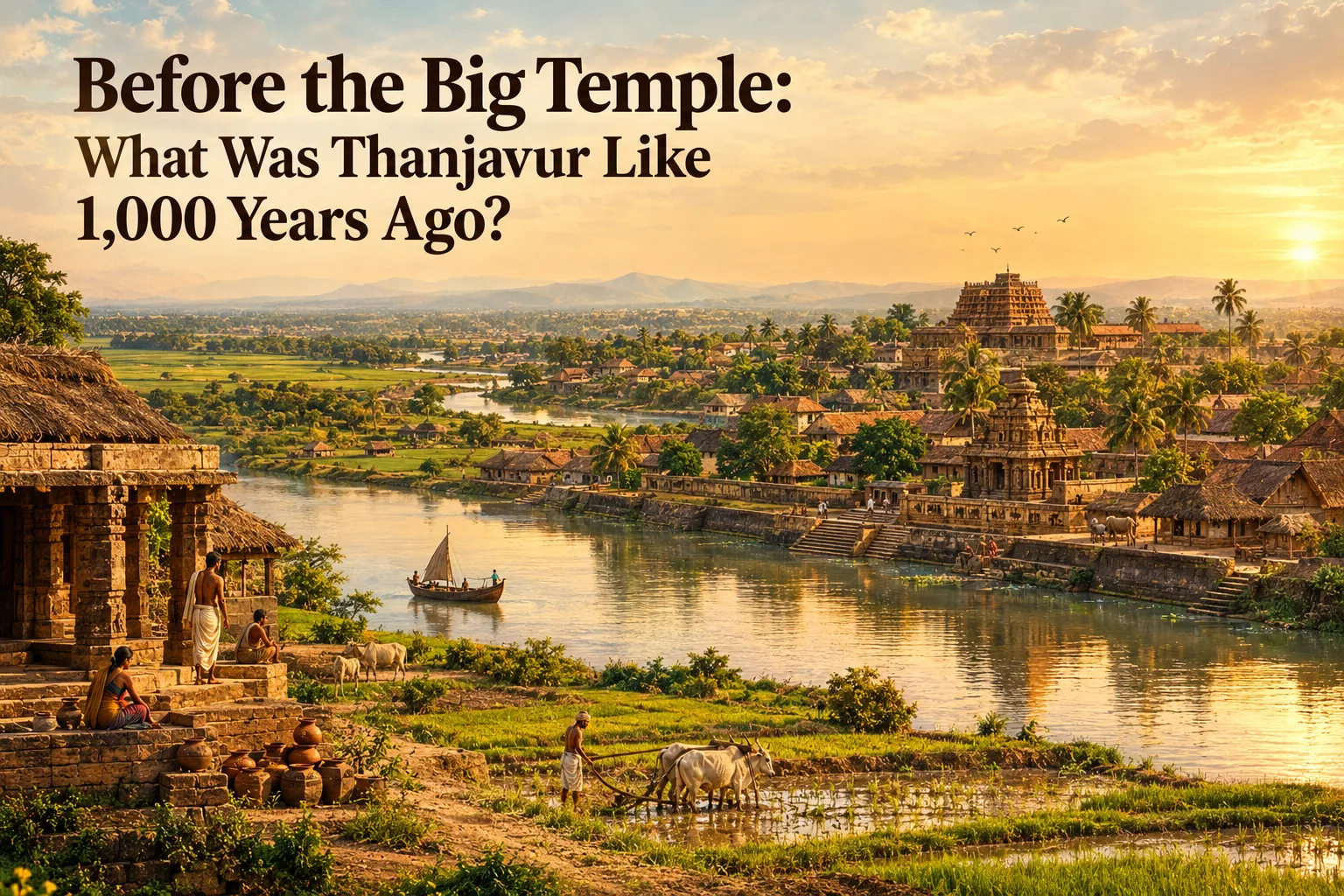
An archival/illustrative representation of early Thanjavur, clearly labelled if reconstructed rather than an actual historical photograph.
Important: Don’t present a modern photograph, later painting or AI reconstruction as if it were an actual image of Thanjavur in 1000 CE.
Recommended internal links
This article can become a major historical pillar page for your Thanjavur Info content strategy. Link naturally to:
The Lost Rivers and Canals of Thanjavur: How Water Shaped the City
Serfoji II: The Most Modern King Thanjavur Ever Had?
The Story of Thanjavur’s First Printing Presses
How Palm-Leaf Manuscripts Were Made, Written and Preserved in Thanjavur
The Forgotten Choultries of Thanjavur
How Thanjavur Became the Home of So Many Art Forms
Thanjavur’s Maratha Kings: What Did They Actually Leave Behind?
This gives you a strong historical sequence:
Water → Early Thanjavur → Cholas → Big Temple → Marathas → Serfoji II → Knowledge → Art & Culture → Modern Thanjavur.
That is much stronger for topical authority and long-term organic traffic than publishing unrelated tourism articles.